You found exactly what you were looking for. The current bid looks good. And if you're new to online auctions, you might be wondering:
Can I trust this site? Is my information safe? And how do I know what I'm actually bidding on?
Those are reasonable questions.
Equip-Bid has been connecting bidders and sellers through online auctions since 2009, and trust is central to the brand. Our vision is to be the most trusted auction platform in the United States, with trust, simplicity, and transparency at the center of the experience.
When you create an Equip-Bid account and participate in an auction, you should feel confident using the official Equip-Bid platform and providing the information required to bid and complete your purchases.
But being a smart bidder still means doing your homework.
A trustworthy marketplace gives you the information and tools to make informed decisions.
Your job is to use them.
Here's what to know before you bid.
First: Is Equip-Bid legit?
Yes.
Equip-Bid is an established online auction marketplace that has been operating since 2009 and connects bidders with auctions for both personal and commercial property.
The Equip-Bid platform gives bidders a consistent place to create an account, browse auctions, place bids, and manage purchases.
That matters when you're entering personal information or participating in financial transactions online.
A good rule is to conduct your Equip-Bid activity through official Equip-Bid pages and the official auction process.
Be cautious if someone unexpectedly asks you to provide account information, passwords or payment outside the normal process.
If something feels unusual, verify it through an official Equip-Bid or seller contact before acting.
Trust the platform.
Still verify unexpected requests.
Not every online auction website is the same
Online auctions are a legitimate and well-established way to buy and sell property.
But "online auction" describes a method of selling something. It doesn't automatically mean every website using that term should be trusted.
When you're evaluating an unfamiliar auction marketplace, look for clear signs that there's a real organization behind it.
That can include:
- Clear auction terms
- Company or seller information
- Legitimate contact information
- Item descriptions
- Photos and videos
- Defined bidding procedures
- Payment information
- Pickup or shipping details
- Clearly disclosed fees
- A way to contact someone if you have questions
You shouldn't have to guess how the transaction works.
Understand how Equip-Bid auctions are structured
Equip-Bid is a marketplace used by several different kinds of sellers.
That means the overall bidding experience happens through Equip-Bid, but specific auction rules can vary.
One auction may offer inspection. Another may not.
One may have loading assistance. Another may require you to bring everything needed for pickup..
Pickup schedules, shipping options, payment procedures and other terms may also differ.
That's why one of the safest habits you can develop is simple:
Read the terms for the auction you're actually bidding in.
Even if you've bought through Equip-Bid before.
Read the auction terms before you bid
Yes, we're recommending that you read the terms.
No, it's probably not the most exciting part of the treasure hunt.
Do it anyway.
Auction terms can contain important information about:
- Payment
- Pickup
- Pickup deadlines
- Inspection
- Loading
- Shipping
- Taxes
- Buyer's premiums
- Auction-specific fees
- Other requirements
Placing a bid means you're agreeing to the rules associated with that auction.
Don't wait until after you've won to find out what those rules were.
Know the buyer's premium
Your winning bid may not be your final purchase total.
Auctions on Equip-Bid have an 18% buyer's premium and a $1.50 item fee, but you should always verify the premium shown for the specific auction you're participating in.
A buyer's premium is a percentage added to the winning bid.
If the auction you're bidding in has an 18% premium, a $100 winning bid would look like this:
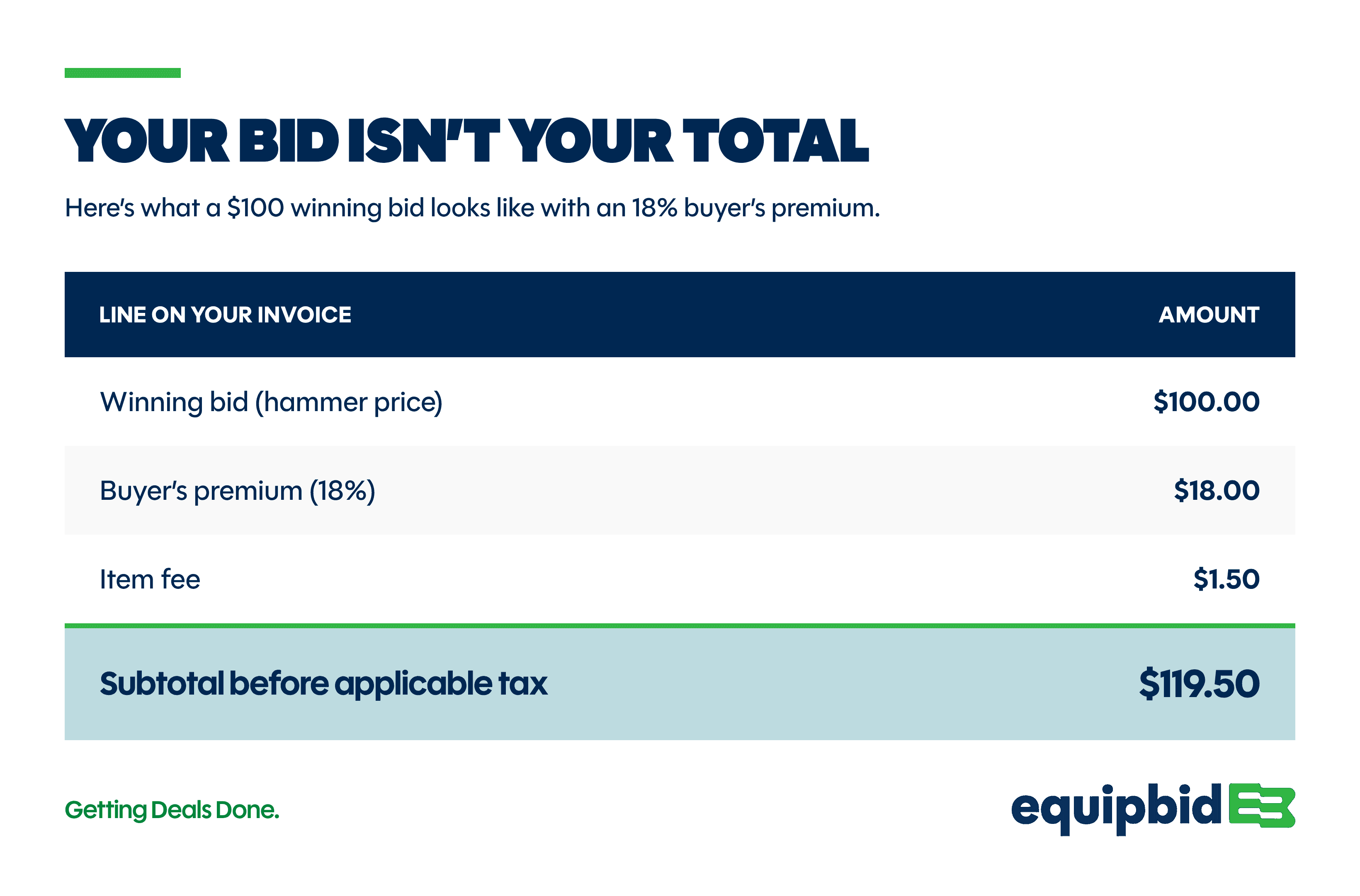
Applicable sales tax and any other disclosed auction-specific charges may also affect the final total.
That's why you should always calculate your budget from the total amount you're comfortable spending, not just the number currently showing on the bid button.
Don't judge an item by the first photo
This one is especially important on Equip-Bid.
Some listings use a stock photo as the first image to help identify the product. That photo can show you what the product is supposed to look like, but it may not show the exact item sitting at the auction location.
That's why you should keep scrolling.
Look through every photo and any videos included in the listing, especially the images or footage showing the actual item.
Those can help you spot:
- Packaging condition
- Scratches or dents
- Wear
- Missing pieces
- Open packaging
- Physical damage
- Included accessories
- Model or identifying information
- Other details about the merchandise
The stock photo can help you recognize the product.
The rest of the photos and videos help you understand the item you're actually bidding on.
Don't stop at image one.
Read the description carefully, and don't fill in the blanks
The description is one of the most important parts of an auction listing. If the seller knows something is wrong with the item, that information should be disclosed in the description.
But the description is also where you need to avoid making assumptions. A good rule is:
If the listing doesn't say it, don't assume it's guaranteed.
For example, maybe a particular power tool normally comes with a battery and charger when purchased new. If the charger isn't mentioned in the description and you don't see one in the photos or video, don't assume it will be there at pickup.
The same applies to:
- Batteries
- Chargers
- Cords
- Remotes
- Attachments
- Hardware
- Manuals
- Accessories
- Extra parts
If something is important to your buying decision and the listing doesn't make it clear, contact the seller before you bid.
A quick message or phone call is much better than making an assumption and finding out later that the item wasn't being sold the way you expected.
Bid on what the listing tells and shows you, not what the product would normally include at retail.
What if there's a product condition listed?
Equip-Bid sellers are not required to assign a product condition label to every listing, but are highly encouraged.
The five primary condition labels are:
- Factory Sealed
- Appears New
- Open Box
- Damaged
- Partial or Incomplete
Factory Sealed
If an item is listed as Factory Sealed, the package must be factory sealed.
The box has not been opened and the product has not been handled.
Because the package has not been opened, however, the contents inside have not been verified. That's why bidders are instructed to inspect Factory Sealed merchandise before leaving pickup.
The uncertainty is about what is inside the unopened package, not whether the item is actually factory sealed.
If the listing says Factory Sealed, that condition standard applies.
Appears New
If an item is listed as Appears New, it looks unused, but the box may be damaged.
It may or may not be in its original packaging, but it has been looked over, does not appear pre-owned and appears complete enough to function.
Open Box
Open Box is the broadest condition.
The item could be like new.
It could be incomplete.
It could be untested.
It could be nonfunctioning.
Its condition or functionality has not been verified either way.
That's why looking through all photos and videos, reading the description, and using inspection when available are especially important with Open Box merchandise.
Damaged
Damaged means the seller knows something is wrong with the item.
That could mean shipping damage, a scratch or dent, or something that is fully broken. The known issue should be communicated through the listing.
Read the description, review the photos and videos, and use inspection when available so you understand what's been disclosed before you bid.
What if there is no condition listed?
No condition label means exactly that:
The seller has not assigned one of Equip-Bid's defined product-condition categories to the item.
It does not mean Factory Sealed.
It does not mean Appears New.
And it does not automatically mean something is wrong either.
It means you need to evaluate the item based on the rest of the listing.
Read the description.
Look through all the photos.
Watch any videos.
Use inspection when offered.
And if something important is unclear, ask the seller before bidding.
Don't fill in missing information with assumptions.
If it matters to your decision, get the answer first.
Use inspection when you're unsure
Sometimes the listing gives you enough information to make your decision.
Sometimes you'd rather see the item yourself.
That's what inspection is for.
When available, inspection can be especially useful for:
- Open Box merchandise
- Items without a product condition
- Damaged merchandise
- Appliances
- Tools
- Vehicles
- Commercial equipment
- Higher-dollar purchases
- Anything where exact physical condition matters to you
Equip-Bid's condition guidance specifically encourages inspection for Open Box items because of how widely that category can vary.
If you're not comfortable bidding based on the information available online, don't guess.
See whether you can look at it in person first.
The description, photos, videos, and inspection work together
No single piece of an auction listing tells the whole story.
Think of each part as another source of information.
The description gives you written details and known issues.
The photos show you what's pictured, including the actual item when those images are provided.
Videos, when included, can give you another look at the merchandise.
A product condition, when used, sets a defined expectation.
Inspection, when available, gives you an opportunity to inspect the physical item yourself.
Equip-Bid's product-condition guidance makes the same point about using descriptions, photos, and inspection to understand what you're bidding on.
The more important the purchase is to you, the more of those tools you should use.
Protect your account information
Safe bidding also means protecting your own information.
Use a strong password for your Equip-Bid account.
Don't share it with anyone.
Be cautious with unexpected messages asking you to provide credentials or payment information.
And if you're ever given payment or account instructions that seem inconsistent with the normal Equip-Bid process, verify them using an official contact before doing anything.
One simple rule covers a lot of ground:
Nobody needs your password to help you with an auction purchase.
Research higher-dollar purchases
Your level of research should probably match the size of the decision.
Buying a $15 household item?
You may be comfortable making that decision pretty quickly.
Buying a vehicle, commercial machine or expensive appliance?
Slow down.
Research the model.
Look at comparable values.
Read every description.
Look through all the actual-item photos.
Watch any available videos.
Inspect when possible.
Understand the terms.
Plan transportation.
Then decide what the item is worth to you.
Safe bidding isn't about expecting every purchase to be perfect.
It's about understanding the information available and making an informed decision.
Know where pickup is before you bid
You don't want to win something and then realize pickup is much farther away than expected.
Before bidding, check:
Where is the item located?
When is pickup?
Do I need an appointment?
Can I actually be there?
How am I going to transport it?
This matters even more for appliances, furniture, pallets and equipment.
A winning bid isn't much fun if you have no practical way to get the item home.
Don't assume someone will load it for you
Loading procedures can vary by auction.
Some locations may offer assistance.
Others may require you to handle pickup yourself.
If you're bidding on something large, check the terms before bidding.
Find out whether you'll need:
- A truck
- A trailer
- Straps
- A dolly
- Tools
- Extra people
- Specialized loading equipment
Don't make the transportation plan after you win.
Make it before you bid.
Set your maximum before the competition gets exciting
Auctions are supposed to be exciting.
That's part of the experience.
But there's a difference between wanting the item and wanting to beat the other bidder.
Before you start bidding, consider:
- Condition
- Comparable value
- What's included
- The buyer's premium
- Applicable sales tax
- Transportation
- Anything else you'll need after purchase
Then decide what you're willing to spend.
If another bidder values it more?
Let them have this one.
There are always more deals ahead.
Pickup is your final opportunity to look things over
This is one of the most important parts of the buying process.
When you pick up your merchandise, take the time to inspect it before you leave.
Make sure it's the correct item.
Check the merchandise against what you purchased.
Review it against the description, photos, videos and applicable product condition.
Open or inspect items when appropriate and permitted.
This is especially important with Factory Sealed merchandise because the contents haven't been verified before the package is opened. Equip-Bid's condition guidance specifically tells bidders to inspect Factory Sealed merchandise before leaving.
And here's the part new you really need to understand:
Once you leave the pickup location with your merchandise, you're indicating your approval of the sale.
If you believe there is a problem, address it before you leave whenever possible.
Once you've taken the item away from the pickup location, refunds, claims, or disputes can become much more complicated.
So don't rush through this step.
Take a minute.
Look at what you bought.
If something doesn't match what was represented in the listing, talk with the auction seller while you're still there. Refer to the seller's terms for returns and refunds before you bid.
Remember: auctions aren't retail stores
This is one of the biggest mindset changes for new bidders.
An auction isn't necessarily the same buying experience as walking into a traditional retailer.
Auction merchandise can come from many sources and in many different conditions.
Some items may have detailed condition classifications.
Some may not.
Some may use stock photography along with actual-item photos.
Some listings may include video.
Some can be inspected in person.
Others may have less information available.
Your job isn't to assume.
It's to evaluate what the listing tells and shows you and decide what you're comfortable bidding.
That difference is part of why opportunities exist at auction in the first place.
Red flags to watch for on unfamiliar auction websites
Equip-Bid is an established marketplace, but if you're evaluating another online auction site you've never used before, use some common sense.
Be cautious if:
- You can't identify who operates the website
- There are no clear terms
- Fees aren't disclosed
- There's no legitimate contact information
- Someone suddenly changes payment instructions
- You're pressured to send money outside the normal process
- Someone asks for your password
- High-value items have almost no information
- You can't determine how you'll actually receive what you're buying
If something doesn't make sense, ask before you pay.
Your safe-bidding checklist
Before placing your next bid, ask:
Am I using the official Equip-Bid platform?
Do I know who is conducting the auction?
Did I read the auction terms?
Did I read the complete item description?
Did I look beyond the first or stock photo and review the actual-item images?
Did I watch any videos included in the listing?
If a product condition is listed, do I understand what it means?
If no condition is listed, am I comfortable bidding based on the other information available?
If something important isn't stated or shown, did I contact the seller before bidding?
Would inspection help me make a better decision?
Do I understand the buyer's premium for this auction?
Do I know the pickup location and schedule?
Can I transport the item?
Have I decided my maximum bid?
Will I inspect the merchandise before leaving pickup?
If you can answer those questions, you're approaching the auction like an informed bidder.
Trust the marketplace. Know what you're bidding on.
So, are online auctions legit?
Yes. And Equip-Bid is built to be a marketplace bidders can trust.
Trust doesn't mean bidding blindly.
It means having a platform, process and information you can use to make your own informed decisions.
- Use the official Equip-Bid platform.
- Protect your account information.
- Read the terms.
- Look beyond the stock photo.
- Review every photo and video.
- Read the description.
- Don't assume something is included or guaranteed if it isn't stated or shown.
- Ask the seller when something matters to your decision.
- Understand condition labels when they're used.
- Don't assume a condition when they're not.
- Inspect when it matters.
- Know your total cost.
- And inspect your merchandise before you leave pickup.
Do that, and you'll be ready for the fun part.
Finding the deal.